How to tailor your resume to a job description in fifteen minutes
Tailoring a resume to a job description means three things: put the experience this role cares about first, describe it in the words the posting uses, and cut what this role does not care about. It does not mean rewriting your history, and it should not take an evening. Done the way below, it takes about fifteen minutes per job, and the result is a resume that both the applicant tracking system and the person reading after it can match to the posting without working for it.
That last part is the whole reason to bother. A recruiter screening a stack of applications reads the top third of each one and searches the rest for the handful of terms the hiring manager gave them. If your resume says "managed client relationships" and the posting says "account management", a search for the second phrase does not find the first. You did the work. The page just does not say so in the terms being looked for.
What tailoring is, and what it is not
It is worth being precise, because the word gets used for two very different activities and one of them is a bad idea.
Tailoring is reordering your bullets so the relevant ones lead, rewording them to match the posting's vocabulary where the match is honest, and dropping lines that have nothing to do with this role.
Tailoring is not adding a skill you do not have, inflating a title, or pasting the posting's keywords into a block of text at the bottom. The first two get found out in the interview. The third gets found out on sight, and a recruiter who spots it stops reading.
The test for every change is simple: could you defend this line, as written, to the person who wrote the posting? If yes, make the change. If you would have to explain what you really meant, you have crossed from tailoring into fiction.
Read the posting the way a recruiter does
Before touching the resume, spend three minutes on the posting with something to highlight. You are looking for four things.
The title, exactly as written. "Senior Product Designer" and "Product Designer III" are the same job at different companies, and your resume should use the one in front of you.
The must-haves. Usually three to five, usually in the first half of the requirements list, often introduced with "required" or stated as years of experience with a named tool or domain.
The repeated words. Anything that appears more than once across the summary, responsibilities and requirements is what the hiring manager actually cares about. A posting that says "stakeholders" four times is telling you something.
The nice-to-haves. Everything after "bonus", "preferred" or "ideally". You will not restructure your resume around these, but if you have one, it earns a line.
Write the must-haves and the repeated words down as a short list. That list is your brief for the next twelve minutes, and it is also what you will check the finished resume against.
The fifteen-minute method
Minutes 0 to 3: the brief
The reading above. Do not skip it to save time. Every tailoring attempt that goes wrong goes wrong here, by guessing what the role wants instead of reading what it says.
Minutes 3 to 8: the summary and the top three bullets
This is where the time goes, because this is what gets read. Rewrite your summary so the first sentence names the role and the two or three must-haves you genuinely meet. Then look at the three bullets directly under your most recent job. Those three are read by nearly everyone who opens the file; the bullets under your third job are read by nearly no one. If the most relevant thing you did is currently bullet six, it becomes bullet one.
Keep the results in the bullets. "Owned the migration to a new billing provider, cutting failed payments by a third" survives a reorder. "Responsible for billing" was never worth the line.
Minutes 8 to 12: vocabulary
Go down the brief and, for each must-have you meet, find the bullet that proves it and make sure the posting's term appears in it. "Client relationships" becomes "account management" if that is what you did. "Wrote SQL reports" becomes "built dashboards in Looker" only if you used Looker. Where the posting uses an acronym, use both forms once, so that "CRM" and "customer relationship management" both match.
This step is where keyword matching is won, and it is also where people get greedy. One honest substitution per must-have is enough. A resume where every bullet has been bent toward the posting reads as exactly that.
Minutes 12 to 15: cut, check, save
Delete anything the brief did not ask for and the role would not value. The internship from six years ago, the certification in a tool this company does not use, the second page that exists only because it always has. Then read the brief and tick off each item you can now find on the page. Save the file under a name that includes the company, so that the version you send is the version you meant to.
The three mistakes that undo the work
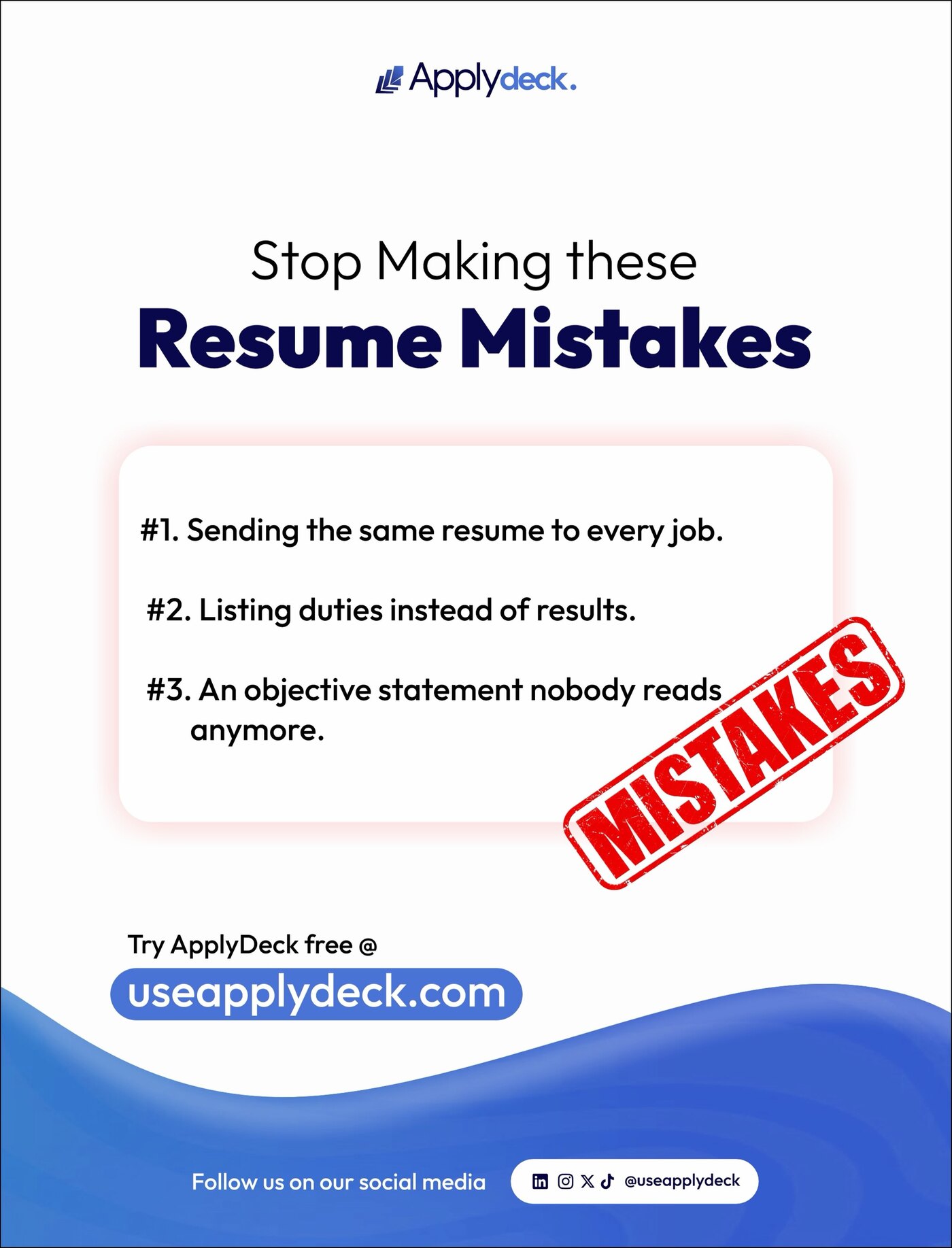
We see a lot of resumes, and the ones that underperform their owners' experience tend to share the same three habits.
One resume for every job. The same file sent to a startup and a bank, to a design role and a research role. It matches neither posting well, because it was not written against either.
Duties instead of results. A list of what the job involved rather than what changed because you were in it. Duties are the same for everyone who held the title; results are the only part that is yours.
An objective statement. "Seeking a challenging role where I can grow" tells the reader what you want from them before you have told them what they get. Replace it with the summary described above, which does the opposite.
What to leave alone
Tailoring has a boundary, and the resumes that get people into trouble are the ones that cross it.
Dates, employers and titles. These are the facts a background check verifies. Reorder around them; never adjust them.
The format. One column, standard headings, a common font, no tables or text boxes. A design change per application is time spent on the part the system reads worst and the recruiter cares about least. The earlier piece on what an ATS actually does with your resume covers why.
Skills you do not have. If the posting wants a tool you have never opened, leave it out. A tailored resume that gets you an interview for a job you cannot do has cost you a week, not won you anything.
A tailored resume is still your resume. If the person interviewing you would not recognise it as your career, you went too far.
How to check it before you send
Three checks, two minutes. First, hold the brief next to the resume and confirm each must-have appears, in the posting's words, somewhere in the top half. Second, read the summary and the first three bullets aloud; anything you stumble on, a recruiter skims past. Third, make sure the role you are applying for appears by name somewhere in the first two lines, so that the first thing a reader sees is the thing they were looking for.
If you would rather not do this by hand for every posting, this is one of the two things the Applydeck resume builder was built for. Pick a job and a resume; it rewrites the resume for that role using only what is already in it, then scores the result against the posting so you can see which must-haves it covers before anything is sent. The fifteen-minute method above is what it is doing, applied every time.
Questions people ask
Does tailoring actually help with an ATS?
Yes, and not for the reason most people think. The system does not reject anyone; it stores your resume and lets a recruiter search and filter the stack. Tailoring puts the terms they search for on your page. The effect is on whether a human finds you, not on whether a machine approves of you.
How many versions of my resume should I keep?
One master document with everything you have done, and one tailored copy per application, named after the company. Never edit the master for a specific job. When you want to tailor the next one, you start from the master, not from last week's version of it.
Is it fine to tailor with an AI tool?
It is fine when the tool works from your own material and shows you every change. It is not fine when it invents experience to fill a gap, which some will do if you let them. Read the output as carefully as you would read a stranger's description of your career, because that is what it is until you have checked it.
Once the resume is right, the cover letter is the next thing most people get wrong. Cover letters are not dead, they are just usually bad is the short version of how to write one that earns its page.
Comments
Loading comments…
Leave a comment
Held for moderation before it appears.
Keep reading

Job application autofill: how to fill out applications faster without sending garbage
You uploaded the CV. The form wants it all typed again. Autofill is the fix, as long as you know what it can read, what it guesses at, and what you still check.